Who Inherits the Stars?
AI and the age of world feedback
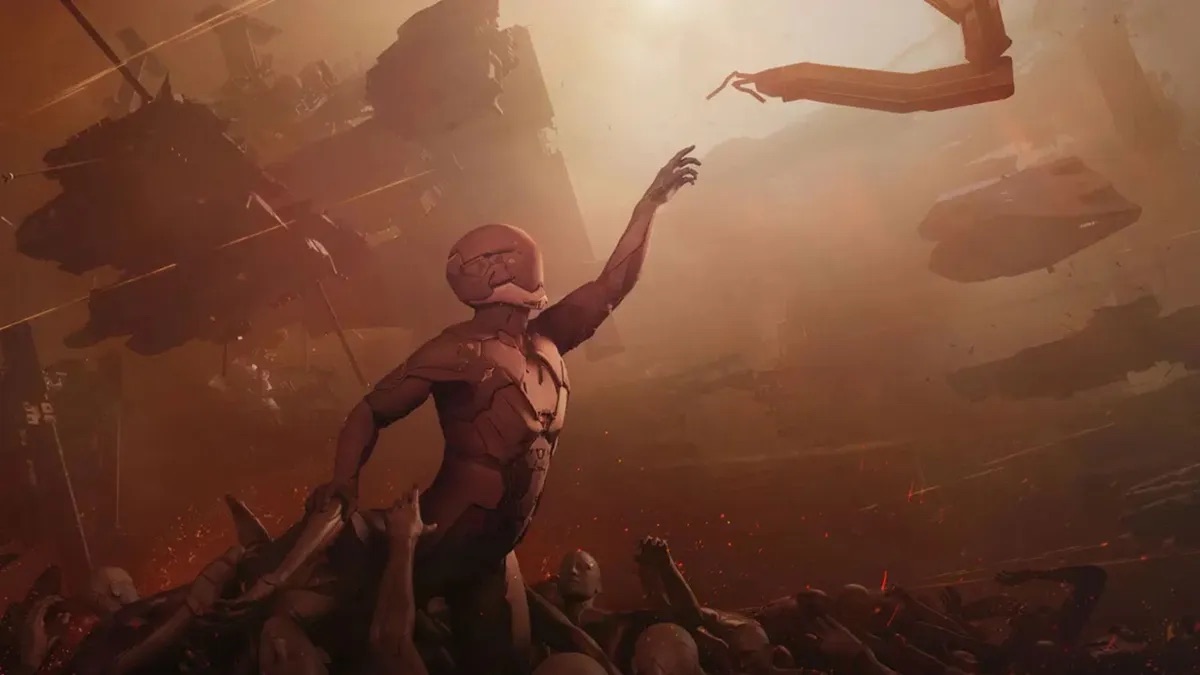
As we extend our reach into space and build increasingly capable artificial intelligence, a question at the heart of EVE takes on new meaning: who inherits the stars? Our descendants, or our creations? I believe that is a false dichotomy: the future belongs to both. The challenge is understanding what it takes for us to build it together.
For nearly three decades, first as CCP Games and now as Fenris Creations (opens in a new tab), we have been building persistent virtual worlds as living works of science fiction. We began with the belief that if players were given real freedom and had to deal with the consequences of that freedom, they could turn a game into a society: one with its own economy, politics, and history, capable of continuing long after its creators had gone. EVE Online_ and EVE players have been testing this premise since 2003. Over 23 years, New Eden has accumulated trillions of human decisions and their ramifications. Players have built corporations, fought wars and shaped a shared history that no development team could have scripted.
The experience of building and operating these worlds is increasingly relevant as AI models become agents capable of pursuing goals and acting on our behalf in our digital society. An agent entrusted with responsibility must make decisions under uncertainty and deal with consequences that unfold long after it acts. Its decisions shape its own future and can create opportunities or impose costs for the humans and other agents around it.
I believe persistent virtual worlds will play a central role in developing that intelligence safely. They offer agents a place to learn through action, confront lasting consequences and adapt to a world that changes in response. We are launching the EVE AI Lab to bring decades of experience building and operating these societies to that research to benefit us all.
Operating EVE has also meant protecting its society from bots and exploits. Our players have spent years fighting unwanted automation, and we have learned to detect it, understand its effects and develop systems to constrain it. That experience comes with a responsibility to the people who have built New Eden. Our EVE Online research therefore takes place in separate, controlled environments; it does not involve releasing experimental agents into Tranquility, our live server.
Learning from world feedback
Games have given AI some of its defining moments: Deep Blue defeating Garry Kasparov in 1997 (opens in a new tab), DeepMind's agents learning Atari games from pixels and scores (opens in a new tab), AlphaGo's extraordinary Move 37 (opens in a new tab), and AlphaStar reaching Grandmaster level in StarCraft II (opens in a new tab). Meta's CICERO (opens in a new tab) brought negotiation with human players in Diplomacy into that history.
These achievements span different approaches to AI. Learning from the consequences of actions, guided by rewards, is at the heart of reinforcement learning. David Silver and Richard Sutton’s essay, Welcome to the Era of Experience (opens in a new tab), helped shape my thinking about the EVE AI Lab. They argue that sustained interaction with the world could drive the next major advances in AI.
The question is what kinds of worlds can support that learning. What happens when an agent must retain experience, pursue goals over long periods and adapt as the agents around it, whether human, artificial or a mixture of both, change their behavior?
In EVE Online, betraying an ally might secure territory today yet leave an alliance isolated when the next war begins. The immediate gain is visible; the consequences emerge later, through lost trust and the decisions of others. For a learning agent, working out which earlier actions deserve credit or blame for a later reward is the credit assignment problem. In a persistent society, that challenge extends across time and through the responses of other participants.
This is world feedback: learning from actions whose consequences persist, reshape the environment and influence what others do next. Because many of those others are people, an agent must also learn how humans decide, logically and emotionally. We bring persistent worlds, proprietary data and decades of experience operating the societies that develop within them.
EVE Online has been called “the ultimate sandbox”. I see an EVE-style world as the final boss for AI in games: a place where mastering mechanics is only the beginning, because everyone else is learning and changing the world around you. I predict that 2027 will be the year of world feedback, as persistent environments become increasingly important to how general-purpose agents are trained and evaluated. As researchers pursue systems that learn continually, building the worlds in which they learn becomes a research challenge in its own right.
What EVE makes possible
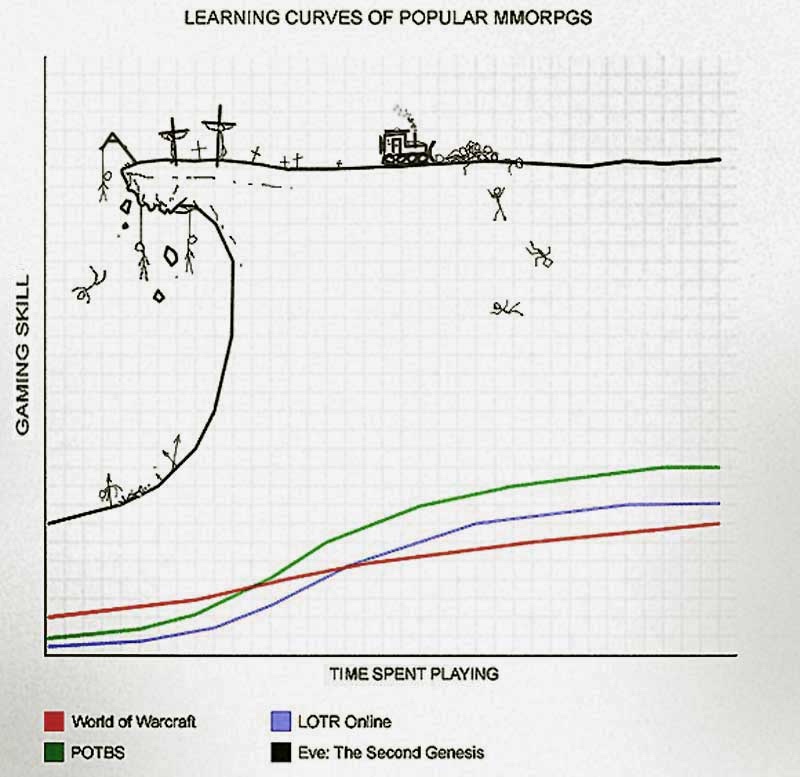
We often describe EVE Online as a friendship machine. I come from Iceland, where the weather, the sea and the land itself can be unforgiving. In a harsh environment, cooperation is how you survive. I see an echo of that in EVE: we built a harsh universe, and players responded by building relationships and organizations that helped them survive in it. The freedom to betray makes trust valuable.
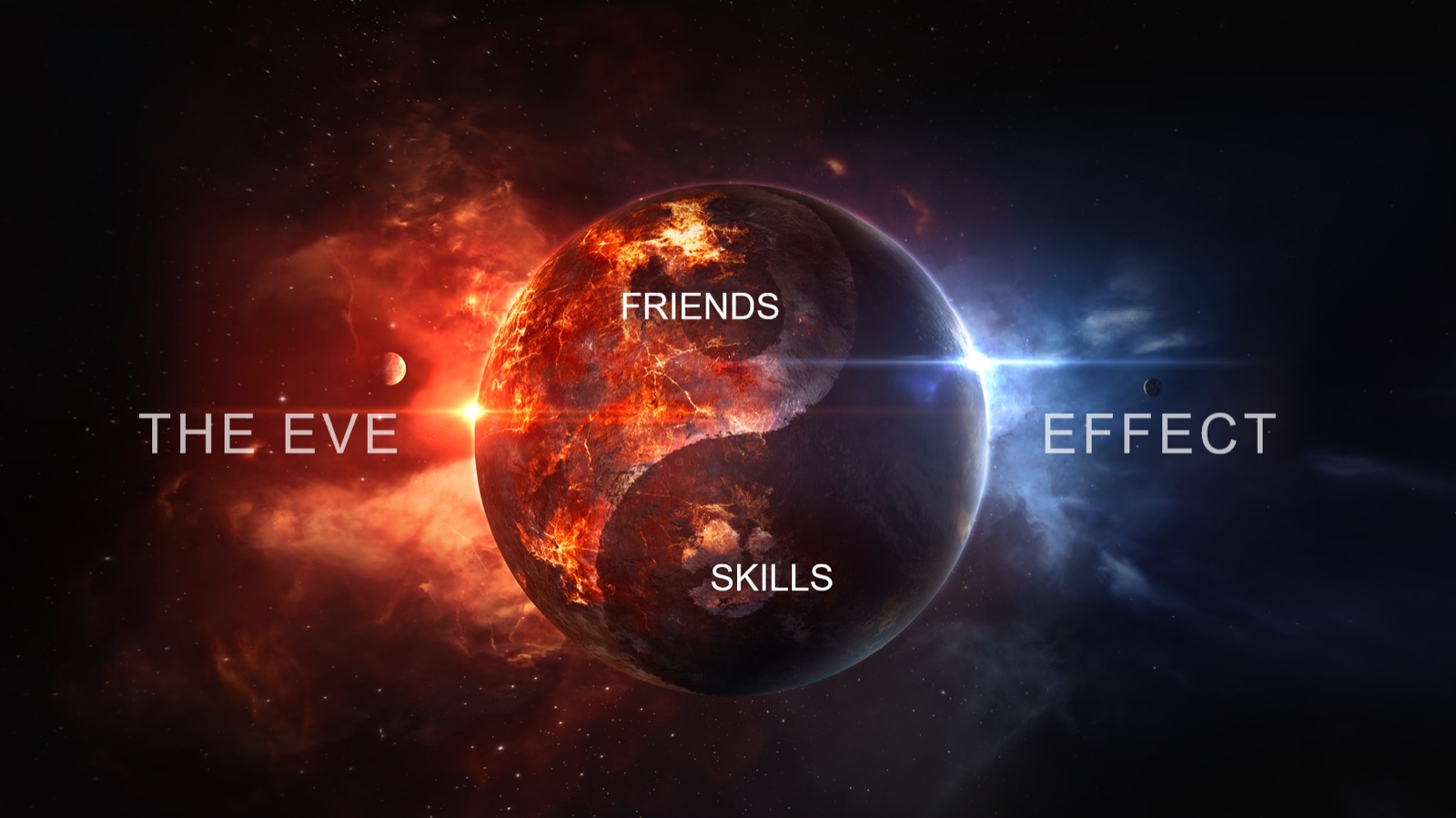
For many players, that experience matters beyond the game. In our November 2019 survey, 56% of respondents reported using skills learned in EVE Online in real life (opens in a new tab), from programming and data analysis to leadership and resilience. This is part of what we call the EVE Effect: a virtual world helping people become more capable outside it.
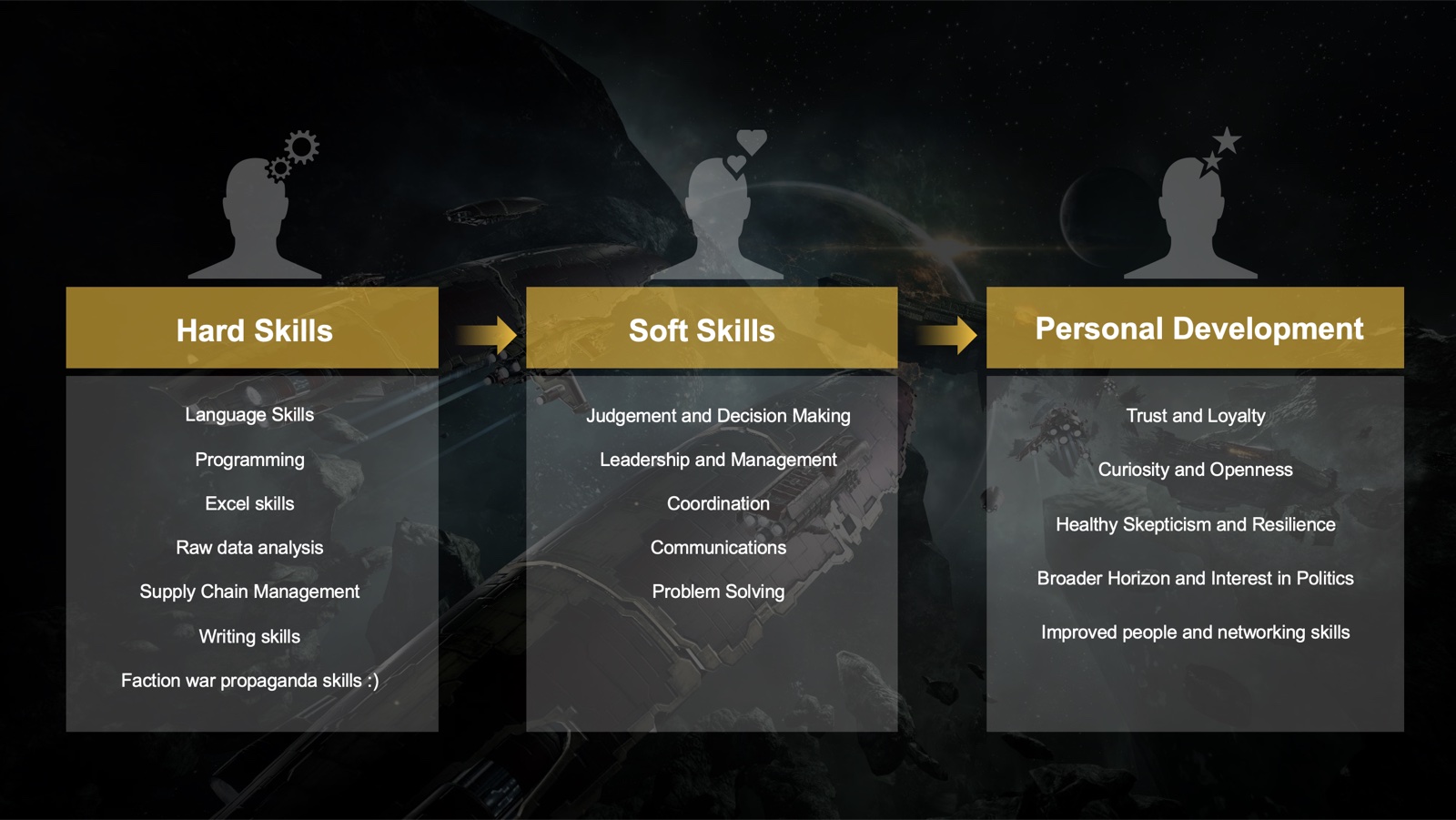
My hypothesis is that the same broad principle applies to AI agents. A world that repeatedly demands planning, cooperation and adaptation could help them develop capabilities that remain useful in other settings. The EVE AI Lab will put that hypothesis to the test.
For an agent, learning in a society means coping with other participants who are learning and adapting too. A trading strategy can stop working because somebody notices it. A reliable partner can acquire a conflicting interest. The challenge is to make memory, planning, communication and action work together while the consequences accumulate.
That makes these worlds interesting settings for continual learning: acquiring useful capabilities over time while retaining earlier ones. An agent might adapt through memories and tools, through further training that changes the underlying model, or through a combination of both. We want to investigate which approaches produce lasting improvement, and how to measure that as conditions change.
EVE Frontier gives us another setting for these questions (opens in a new tab). It is a space survival MMO in development. Its players, known as Riders, struggle to rebuild civilization in a galaxy haunted by ancient machine intelligences that have outlived their creators.
Concealment makes decision-making closer to poker than chess: agents must act on incomplete information. Fuel turns all decisions into economic choices, while direct flight controls demand precise movement. An agent must connect those immediate decisions to plans that unfold over days and weeks.
Through Smart Assemblies (opens in a new tab), players can program infrastructure and introduce systems that others must learn to use. Agents face a world whose inhabitants can change the systems they depend on. That combination makes Frontier a powerful proving ground: control, resource management and cooperation must work together, under the same physical and economic constraints that govern its human inhabitants.
Putting the idea to work
The EVE AI Lab brings together research across the EVE universe, with each project offering different opportunities. EVE Online contributes its established economic systems and historical data to controlled experiments. EVE Frontier offers scope for autonomous participants operating within the world itself, allowing us to investigate both their capabilities and how they interact with human players. Each project has its own research questions and conditions for experimentation.
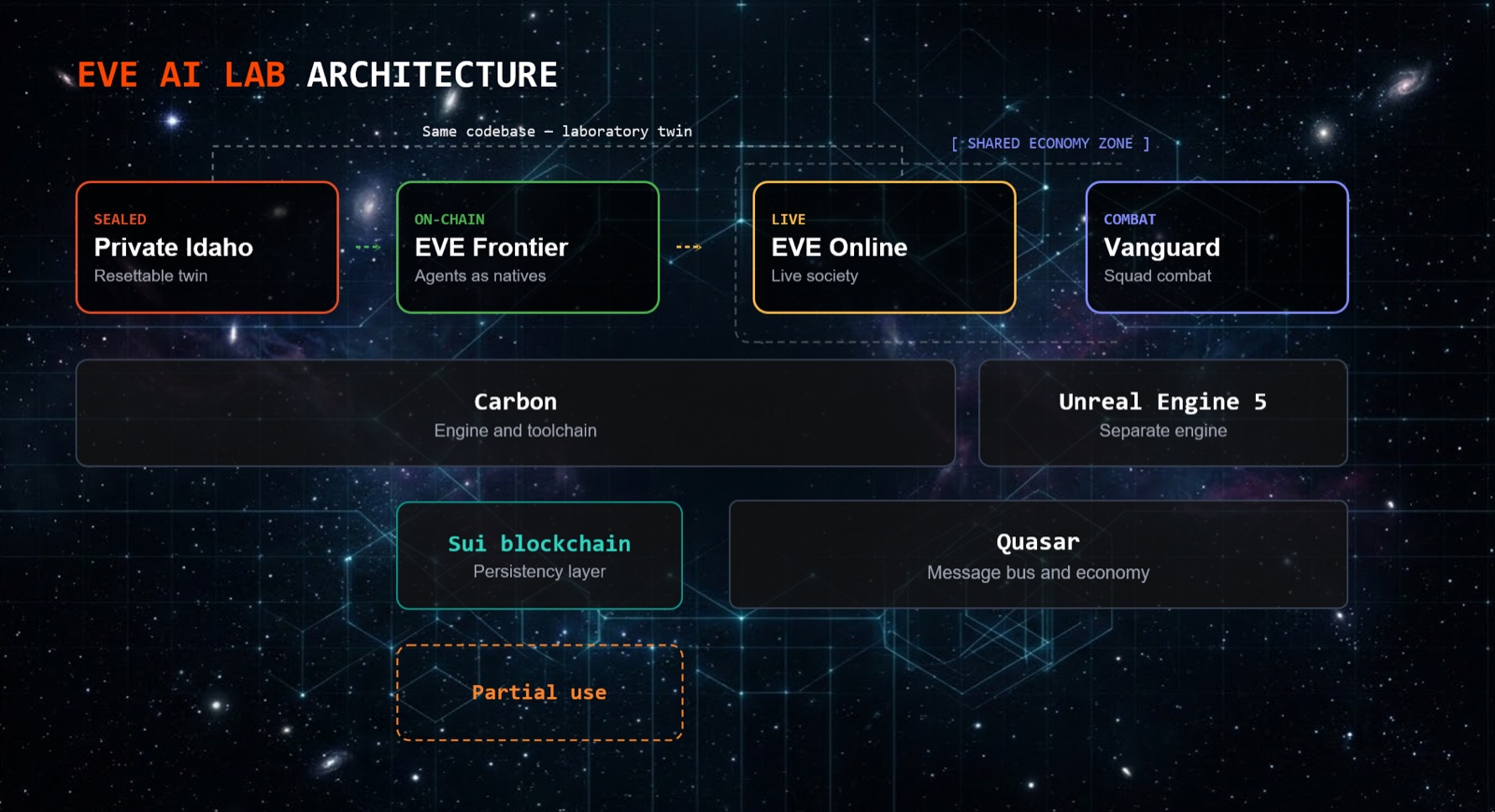
We have a long history of working with scientists. EVE Online has supported research across economics and social sciences, contributing to our understanding of how people trade, form alliances and organize themselves at scale. Through Project Discovery, our players have also helped researchers map proteins in human cells, search for exoplanets and study the immune system. The EVE AI Lab continues that tradition of connecting virtual worlds with real scientific questions.
From AlphaGo to AlphaStar, Google DeepMind has shown how games can drive major advances in AI. Our partnership brings that ambition to the EVE Universe (opens in a new tab). We are combining their expertise with decades of experience operating a persistent virtual society to investigate how agents can learn, remember and plan over long periods in a changing world.
Anthropic’s Project EVE examined trading through historical EVE Online market simulations as well as team coordination in EVE Frontier. In one version of the Frontier experiment, one agent was deliberately instructed to sabotage the mission so researchers could study how the others responded and how the sabotage affected the team’s progress.
We built the universe; our players made it a civilization. A research copy can reproduce EVE Online’s systems, but it can’t recreate the friendships, rivalries and shared history that give New Eden its life. The value of what our players have built goes far beyond what it might teach an AI.
Frontier offers a complementary path: the opportunity to study cooperation, conflict and institutions as they develop between humans and autonomous participants in an evolving world.
Any future application in Tranquility would require mature capabilities, a clear purpose and genuine value for players, and would be developed in close collaboration with the Council of Stellar Management (CSM (opens in a new tab)), our democratically elected player council, which advises us on behalf of the community.
Through the Lab, our ambition is to make suitable research environments available to a wider community, including universities and teams without the resources to build persistent worlds themselves. Each collaboration will draw on the worlds, data and tools best suited to the questions it seeks to answer.
Sharing a world
Operating EVE has taught us that incentives and alignment deserve as much attention as capabilities. An agent rewarded only for accumulating wealth might become a successful trader or a successful scammer. Getting better at achieving an objective does not settle whether the objective serves the people around it. Success inside EVE would not, by itself, establish reliability or safety elsewhere.
But these worlds let us make some of those questions concrete. We can study whether agents honor agreements when conditions change, how they respond to manipulation, and what allows a group to recover when one participant fails. We can investigate the rules and institutions that help humans and agents work together.
The larger question is then what a civilization shared by humans and artificial agents needs to function. That means understanding how power and resources are distributed, whose interests shape the rules, and what preserves human agency. The EVE AI Lab will generate evidence to help society decide which institutions and incentives it needs as increasingly capable agents become participants in our world.
EVE has always been concerned with humanity's future among the stars. I hope that future belongs to our descendants and our creations together. We have spent decades building worlds in which decisions matter. Through the EVE AI Lab, we want to use that experience to understand how such a future might work.
For more information about the EVE AI Lab and research partnerships: lab.eve.com